
V-J DAY. WHAT DOES IT MEAN?
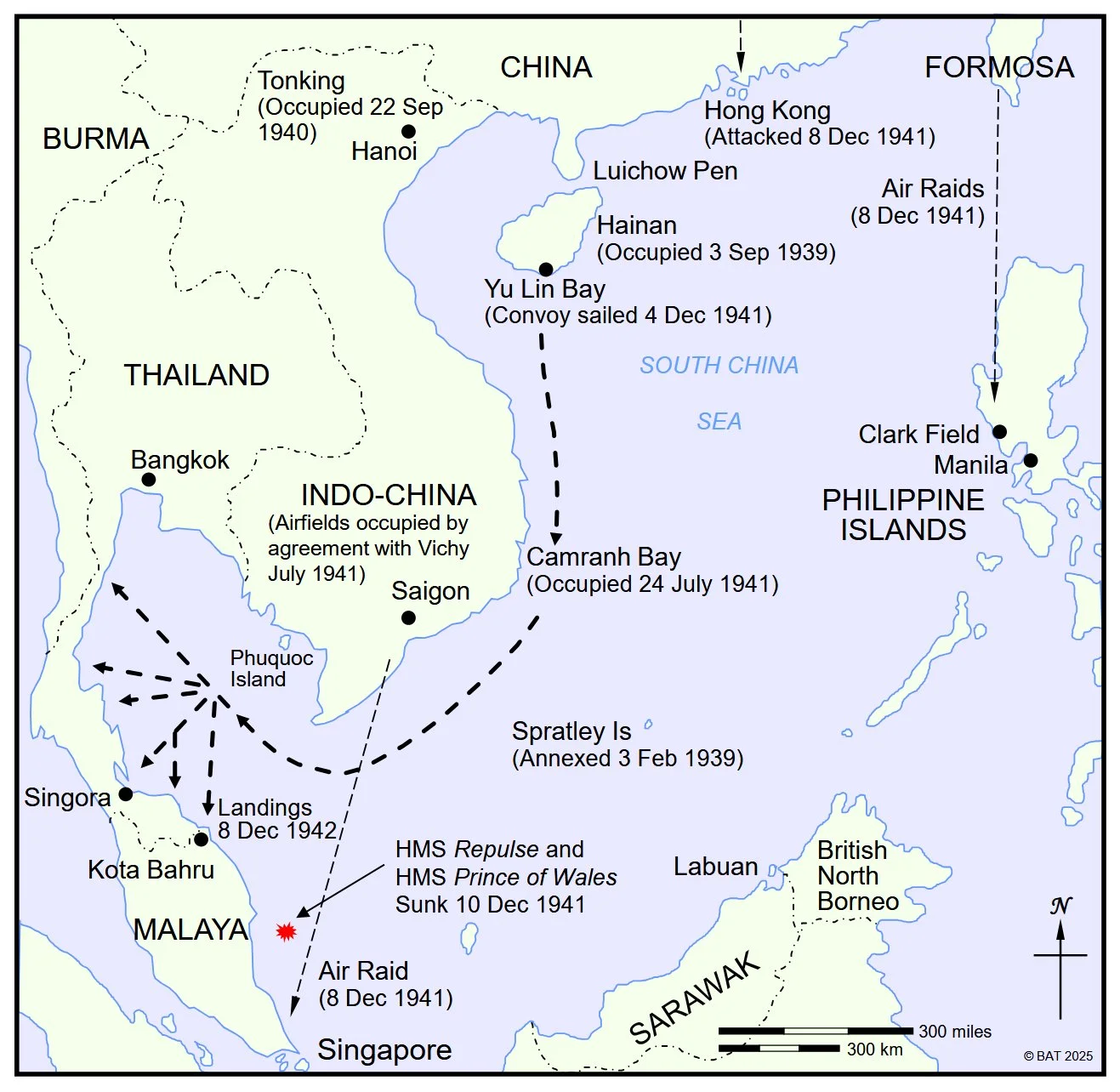
Map 1: Japanese Invasion
Map 1 graphically illustrates the breadth of the initial Japanese attacks while Map 2 shows the disposition of the Garrison on Singapore Island just before the surrender to the Japanese,
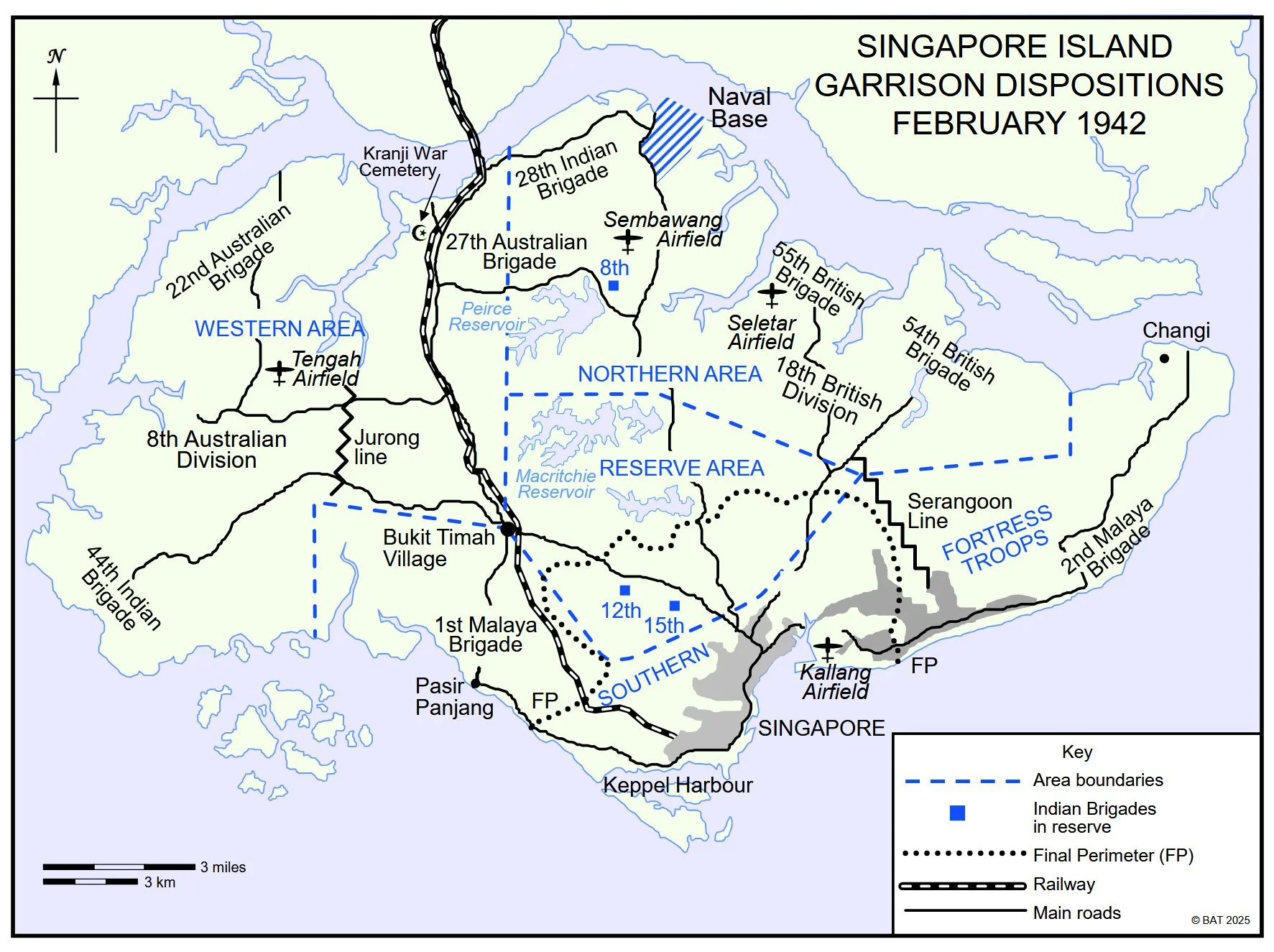
Map 2: Singapore Island
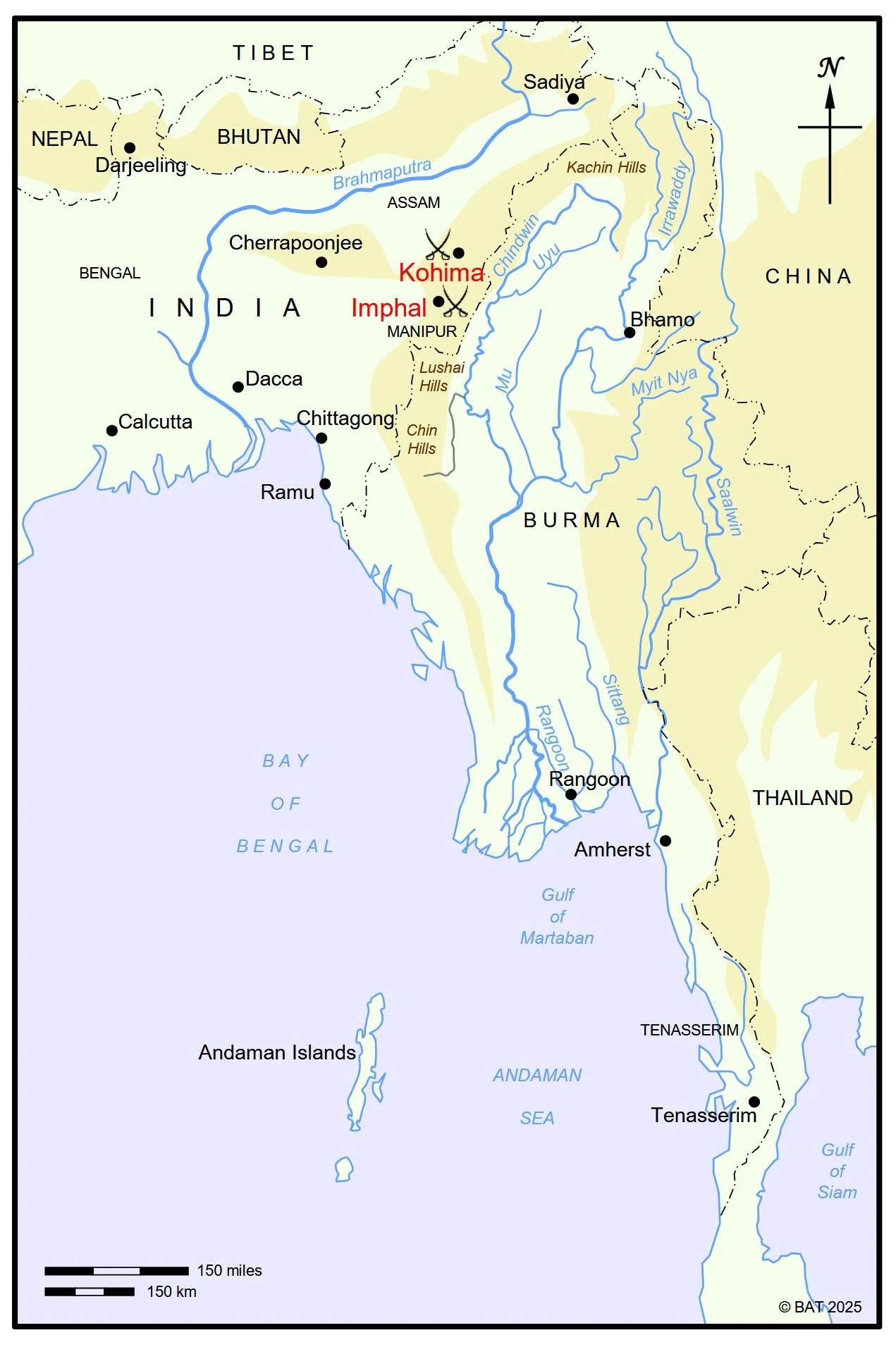
Map 3: Burma and East India
It took the Japanese just four months to defeat British and allied forces in Burma and force a withdrawal to India. 17 th Indian Division, which was to play a significant role throughout the Burma campaign, bore the brunt of the onslaught and, during the retreat, suffered another major setback in the Sittang area when the Brigade Commander responsible for holding the Sittang Bridge ordered it to be destroyed, leaving two Brigades on the wrong side of the river. Shortly after this disaster the then Lieutenant General William Slim arrived in Prome in March 1942 to take charge of a newly-formed 1 st Burma Corps. By 28 April, and realising that much of the
British force had been decimated, the order was given to withdraw from Burma. By May most had reached India, though some elements remained in Burma. The Japanese went on to occupy a part of North East India.
From December 1942 through to mid-1944 there were a number of operations in the Arakan and North West Burma. General Slim had been appointed to command the new British Fourteenth Army in October 1943, his one aim to re-take Burma. Although ‘British’ in name, actually only two of the twelve Divisions in Fourteenth Army were British; seven were Indian and three came from West Africa. Among the Indian Divisions there were, of course, many thousands of Muslim soldiers, but we also remember those from West Africa, in particular those from Nigeria, many of
whom were Muslim. Slim set about an intense period of training of his Army, including a focus on repairing morale. Dubbed by its own British soldiers as ‘The Forgotten Army’, this somewhat Euro-centric opinion reflected a number of issues: the focus in UK was on Germany and the war in Europe with much more media coverage; for the British soldiers involved Burma was a long way from home, they had problems with mail to and from home and many of them had been there a long time so felt ‘forgotten’; and Winston Churchill, who had a biased and low opinion of
the Indian Army, ignored their successes. This is in no way to deny the legitimacy of their complaint, but within India, however, it was far from ‘Forgotten’; there was obviously a far greater awareness of the “enemy at the gates”; the war in Burma was initially directed from India, though after the formation of South East Asia Command in August 1943 and the move of its headquarters to Kandy in Ceylon (Sri Lanka) in April 1944 that link was broken; casualties were evacuated to and treated in India, where many of them died and were either buried or cremated there according to their faith; the requisitioning of land and draining of paddy fields in order to create several hundred airfields that would support the air superiority over Burma, or allow for the construction of factories and warehouses affected many hundreds of thousands “and the members of many of these families became famine victims in 1943.” 1
General Slim’s plans started with clearing the Arakan and Mayu Peninsula. This saw particularly fierce battles at Buthidaung (16 January – 3 February and 5 March – 8 April 1944); Razabil (19-30 January and 10-17 March 1944); Maungdaw (1 January - 31 May 1944); and Ngakyedauk Pass (4 February – 4 March 1944), where the Admin Box staffed initially by cooks, drivers and other support personnel of 7 th Indian Division with elements of 5 th Indian Infantry Brigade and 81 st (West Africa) Division, successfully fought off a determined Japanese attack. The turning point came in a series of three battles fought between 27 March and 22 June 1944 around the town of Kohima. First, the Japanese attempted to capture Kohima ridge, a key re-supply
route for British and Indian forces of IV Corps based at Imphal. Then British forces counter-attacked and drove the Japanese from positions they had captured and finally, in the third phase British and Indian troops pursued the retreating Japanese, finally clearing the road to Imphal. On 8 July 1944 Lieutenant General Mutaguchi, commander of the Japanese 15 th Army, accepted that his venture had failed and ordered the remnants of his force (he had lost close to 150,000 men) to withdraw
across the Chindwin.
As the Japanese retreated towards the Irrawaddy so General Slim sent IV Corps and XXXIII Corps after them to clear the Mandalay-Meiktila Plain. Meiktila was seized on
5 March 1945 and Mandalay on 20 March. 17 th Indian Division reached Pegu at the beginning of May 1945 and 26 th Indian Division secured Rangoon after the Japanese had vacated the city. The dropping of atom bombs on Hiroshima (7 August 1945) and Nagasaki (8 August 1945) led to the Japanese suing for peace, on condition that the Emperor could stay on the throne. This was agreed to and the Second World War ended on 14/15 August 1945. There are 19,643 Indian troops commemorated on the Rangoon memorial with a further 460 at the Rangoon War Cemetery and 1833 at Taukkyan. A sizeable number of these will be Muslims, though we do not have precise figures. Taukkyan also commemorates a further 981 on the cremation memorial for those whose faith called for them to be cremated.
Map 3 shows the general area of the Burma campaign. We aim to supplement this with more detailed maps in the coming months as we expand on the story of the Indian Army’s historic role.
Field Marshal Sir William (later Viscount) Slim wrote of the Indian Army “My Indian divisions after 1943 were among the best in the world. They would go anywhere, do anything, go on doing it, and do it on very little.” 2
Although not a part of V-J Day, it should be remembered that Indian troops were
engaged in a number of post-1945 operations in the Far East, especially in the Netherlands East Indies (now Indonesia); 23 rd Division from September 1945 to October 1946, 26 th Division from October 1945 to November 1946 and 5 th Division from November 1945 to April/May 1946. There are a number of Muslim casualties recorded at the Jakarta War Cemetery.
Bibliography
Chhina, Rana. Last Post. Indian War Memorials Around the World. New Delhi: Centre for Armed Forces Historical Research, United Service Institution of India, 2014
Elliott, Major General J.G. A Roll of Honour : The Story of the Indian Army 1939-1945. London: Cassell, 1965
Kempton, Chris. Loyalty and Honour. The Indian Army September 1939-August 1957, Part 1, Divisions. Milton Keynes: The Military Press, 2003
Khan, Yasmin, The Raj at War: A People’s History of the Second World War. London: The Bodley Head, 2015
Rodger, Alexander. Battle Honours of the British Empire and Commonwealth Land Forces 1662-1991. Ramsbury: The Crowood Press, 2003
Slim, Field Marshal Sir William. Defeat into Victory. London: Cassell and Company Ltd., 1956
Acknowledgement
Maps by Barbara Taylor
1 Famine Inquiry Commission, Report on Bengal (Delhi: Government of Indian, 1945, p,27 quoted in Khan, Yasmin, The Raj at War: A People’s History of the Second World War. London: The Bodley Head, 2015, p.164.
2 Field Marshal Sir William Slim. Defeat into Victory. London: Cassell and Company Ltd., 1956, p.539
SUPPORT US
The WWMMT continues to raise funds for the maintenance of the memorial and for an educational programme focussed on the history of the role Muslims played in the two World Wars and since. If would like to support the Trust and its ongoing work, please donate.
Click to share this page on your social media


