
Dunkirk and Force K6
This week marks the 86th anniversary of the start of the Dunkirk evacuation in 1940. Beginning on 26th May and lasting until 4th June more than 338,000 allied soldiers were evacuated from the beaches of Dunkirk, in the north of France, and safely brought to England. A second operation, conducted between 15th and 25th June, saw another 192,000 troops safely evacuated from La Baule and St Nazaire in western France. Very few people realise that among that large number of mainly British, French and Belgian soldiers were almost 1,600 Indian soldiers, the vast majority of them Muslims, serving with the Royal Indian Army Service Corps (RIASC) in Animal Transport (Mule) units and their affiliated support units.
When the British Prime Minister Neville Chamberlain announced on 3rd September 1939 that Britain was at war with Germany, he was referring not only to the United Kingdom but also to the whole of the then British Empire – the dominions of Australia, New Zealand, Canada and South Africa and all of its colonies and overseas territories, including then undivided India. The British Expeditionary Force (BEF) sent across to France at the beginning of the war could only hope to hold a line against anticipated German advances until such time as the reserves could be built up. Initial thoughts by the planners were that no animals would be used, as they had been in the First World War; all supplies of food, fuel and ammunition for the front would be transported there by road and rail. The problem, as was very quickly realised, was that the roads and railways stopped short of where the troops would be digging in and the ground in between would likely become impassable to vehicles during bad weather.
Even before war had been declared, therefore, the Indian Army was asked to provide mules, transport carts and mule handlers since the British Army had very few on their books. Orders were issued in the Punjab to prepare such a force and fouranimal transport companies of the RIASC were mobilised. The formation, to be known as Force K6, was made up of 22nd, 25th, 29th and 32nd Animal Transport Companies (Mule), each company consisting of about 300 men and 300 mules, and the essential support network that would be required to keep them fully operational: a Reinforcement Unit to replace men taken ill or wounded, an Advanced Remount Depot to look after the flow of animals, No 47 Supply Depot Section which would look after all supplies of food and equipment for the men and fodder for the animals, one section of an Indian General Hospital to look after wounded and sick men, and men attached from the Indian Army Veterinary Corps to look after the health and welfare of the animals. To avoid difficulties of separate feeding arrangements for the men depending on their religion or class it was decided that all personnel would be Muslims drawn from the Punjab and North West Frontier of India. Essential support personnel such as sweepers, cooks, water carriers, bootmakers and tailors might have been drawn from the Hindu, Sikh and Christian communities.
The convoy of ships carrying Force K6 left Bombay on 10th December 1939 and landed at Marseilles on 25th December. 22nd Company was sent to join the French 3rd Army, 25th Company to British Second Corps near Lille, 29th Company to the Line of Communications base near Le Mans and 32nd Company to British First Corps on the Belgian border at Orchies. The first four months of their time in Europe was spent in the so-called Phoney War, with time for training and social events, but everything changed on 10th May 1940 when German forces invaded France and Belgium.
During that short Battle of France, the BEF lost 68,000 men, including four RIASC soldiers on their way from the Reinforcement Unit to join 22nd Company. The decision to evacuate the BEF was taken by Prime Minister Winston Churchill and initial plans for Operation DYNAMO focussed on using the ports of Boulogne, Calais and Dunkirk. However, a blitzkrieg by German forces destroyed Boulogne and Calais and so efforts concentrated on Dunkirk. The BEF was forced to abandon all of its equipment; Force K6 was ordered to abandon its mules, which came as a hard blow to the muleteers who had looked after them since they left India. Many British and French soldiers were lost in German air attacks on the beaches and rescue ships at Dunkirk but two companies of Force K6, 25th and 32nd were successfully evacuated.
The evacuation from Dunkirk still left about 140,000 troops in France based on the lines-of-communication, base depots and other establishments. This number included about 1,000 men of Force K6 drawn from 29th Mule Company, No 47 Supply Depot, the Reinforcement Unit, the Advanced Remount Depot and the Indian General Hospital. During Operation AERIAL, conducted between 15th and 25th June another 192,000 troops were safely evacuated from La Baule and St Nazaire.
The c.300 men of 22nd Mule Company, which was serving with the French, were unable to get away and on 25th June surrendered to German forces and became prisoners of war. Over time they were joined by other Indian prisoners of war captured in North Africa or Italy. In May 1944 an American air raid on Épinal led to a mass breakout of Indian troops from their POW camp. Eventually about 300 men (not all RIASC) made their way to Switzerland and freedom while others died or were killed by the Germans.
Those members of Force K6 who reached England from Dunkirk or the west of France were soon to be re-designated the Indian Contingent. Initially dispersed around the country, some were reunited at Ashbourne, Derbyshire, before moving later to Salisbury Plain and to Devon and Cornwall where they stayed until April 1941. The photograph shown with this article was probably taken at this time. The caption reads “Led by a native piper, troops of the Indian Army Service Corps march along the coast. These men were evacuated from Dunkirk, have been re-equipped and provided with fresh mules, and are now playing their part in the defence of Britain.” [1]
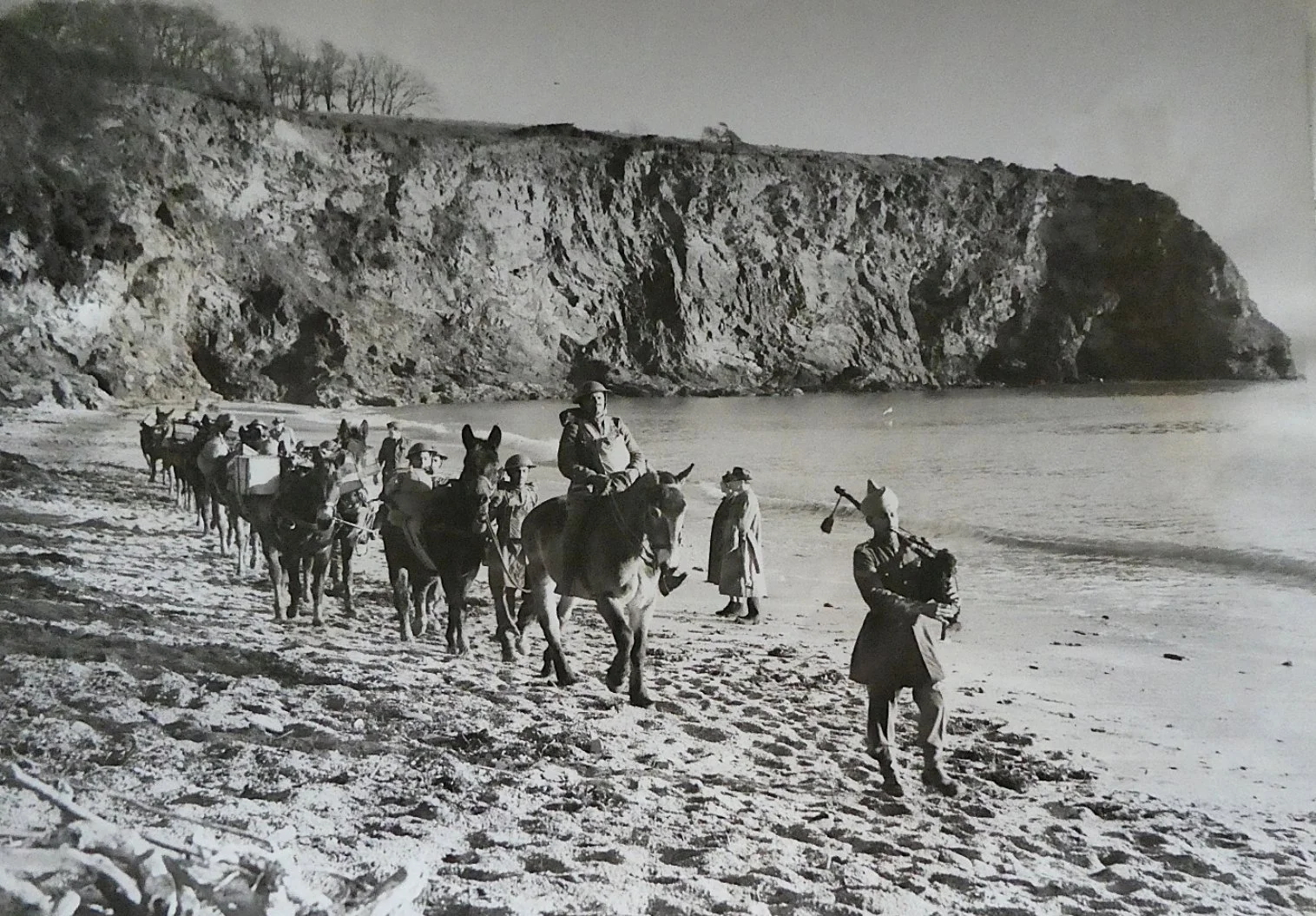
The whole of the Indian Contingent was then reunited at Crickhowell in Powys, Wales where they were joined by three new mule companies sent from India – 3rd, 7th and 42nd. There was now a total of 3,400 men and a similar number of mules in the unit, though some were soon dispersed again as far afield as Colchester in Essex. Military planners were now having to devote an enormous amount of time and effort to another of Winston Churchill’s ideas – the invasion and occupation of German airfields in northern Norway. The Indian Contingent was earmarked to provide first-line transport taking ammunition and food to troops at the front. The plan never materialised, but for the remainder of the Indian Contingent’s stay in the UK it provided the focus of their intense training. This included a move by the bulk of the unit to the Scottish Highlands in July 1942. They spread across the country, the Indian General Hospital being located at Aviemore, in the Cairngorms mountain range, and from here those who died as a result of illness or training accident were buried at Kingussie Cemetery where a memorial tablet unveiled in September 2022 now marks their service and sacrifice.
The Indian Contingent was broken up in January 1944 and the men sailed for India, arriving in Bombay on 13 February. After a period of leave, and with the war against Japan at its height, the Mule Companies were each reassigned to new roles. The Commonwealth War Graves Commission website for World War 2 casualties shows a total of 21 men of the RIASC commemorated in France, the majority of them Muslims, with a further 37 RIASC Indian names commemorated around the UK, including the Kingussie Cemetery (there are other names on the lists for British officers and NCOs serving with the unit). See www.cwgc.org/find-records/find-war-dead/ . If you want to see the whole record ignore the section for name, rank and number. Under “Regiment” enter Royal Indian Army Service Corps; under “Served with (country)” enter India; under “served in” enter army; under “War” select Second World War; in the additional fields select “Country (commemorated in) and then go to either France or UK.
SUPPORT US
The WWMMT continues to raise funds for the maintenance of the memorial and for an educational programme focussed on the history of the role Muslims played in the two World Wars and since. If would like to support the Trust and its ongoing work, please donate.
Sources
1 KY. 14123 – R/438301. Private collection.
References
Bowman, Ghee. The Indian Contingent – the forgotten Muslim soldiers of Dunkirk, (Cheltenham, The History Press, 2020).
Bowman, Ghee. The Great Épinal Escape: Indian Prisoners of War in German Hands (Cheltenham, The History Press, 2024).
Kempton, Chris. Loyalty & Honour – The Indian Army September 1939-August 1947, Part III, (Milton Keynes, The Military Press, 2003).
Wade, Shamus O.D. But Where Did the Mules Come From? Durbar, Journal of the Indian Military Historical Society, Vol 17, No 4, Winter 2000, pp.122-130
Formal Multifaith Remembrance Service - Paying tribute to Force K6, Kingussie - Colourful Heritage (accessed 20 May 2026)
Click to share this page on your social media


