
The loss of the SS Ramazan, 19 September 1915
On 19 September we commemorate one of the greatest number of Indian Army losses in the Gallipoli campaign of the First World War. The vast majority of those lost were Muslim members of the Transport Corps, who died when the ship on which they were travelling as reinforcements for the Dardanelles was attacked and sunk by a German U-boat.
This loss, and the need to remember those who died, provides an opportunity to explore briefly the role of the Indian Army in the failed Dardanelles campaign of 1915. As Rana Chhina noted “The object of the Gallipoli campaign was to force the passage of the Dardanelles and get a fleet of British and French warships to Constantinople, hoping thereby to force the surrender of Turkey and bring about a speedy conclusion of the War in the Middle East.” [1] The operation was the brainchild of Winston Churchill, then British naval minister. Most strategists regarded the idea as unwise unless at least one of the two shorelines covering the Dardanelles – the Gallipoli Peninsula to the north or the shore of Ottoman Asia Minor to the south – was secured by land forces. The naval plan was launched on 19 February 1915 but was met by heavier than expected Turkish defensive positions and the plan failed on 18 March when an attempt to rush the Straits by British and French warships was thwarted, with losses to both navies.
In the rushed planning for the operation, it was not until mid-February that a land force of Australian and New Zealand troops, who were then based in Egypt, was given orders to stand by. On 12 March General Sir Ian Hamilton was appointed to command the British Mediterranean Expeditionary Force, initially comprising some 75,000 men, mostly untried Australian and New Zealand troops, though it also included Hindus, Sikhs, Muslims and Gurkhas of the Indian Army – earlier accounts reckoned about 5,000 in total though Peter Stanley [2] has increased that number to closer on 16,000. Whatever the actual number, the punch that the Indian Expeditionary Force packed and the contribution that it made was considerable. For all of its contribution, however, it barely merits a mention in the Official History or in other contemporary histories, the honour of the Dardanelles campaign going largely to the Australian/New Zealand Army Corps (ANZAC). That shortcoming has been addressed in recent years with a number of excellent books but much still needs to be done to set the record straight.
Indian Expeditionary Force ‘G’ comprised 7th Indian Mountain Artillery Brigade, including 21st (Kohat) Mountain Battery (Frontier Force) and 26th (Jacob’s) Mountain Battery. Both contained a sizeable number of Muslims and many years later, during the Second World War, both were reorganised into all-Muslim units. Force ‘G’ also comprised 29th Indian Infantry Brigade which initially consisted of a mixture of Sikhs, Muslims and Gurkhas. Early planning for the expedition did not include transport, “since Lord Kitchener expected that the landing force would be required only to march over the narrow peninsula.” [3] Eventually Kitchener was persuaded otherwise and, given the lack of roads on the peninsula, an Indian Mule Cart Train from France was allocated to the expedition. This comprised four new Mule Cart Corps, each consisting of 10 troops, each of which had 108 mules, 50 carts and 60 drivers. They were drawn from a large swathe of the Indian Mule Corps, including detachments from three of the Princely States – Bharatpur, Indore and Gwalior. The Mule Cart Train embarked on their transports from Marseilles in early April.
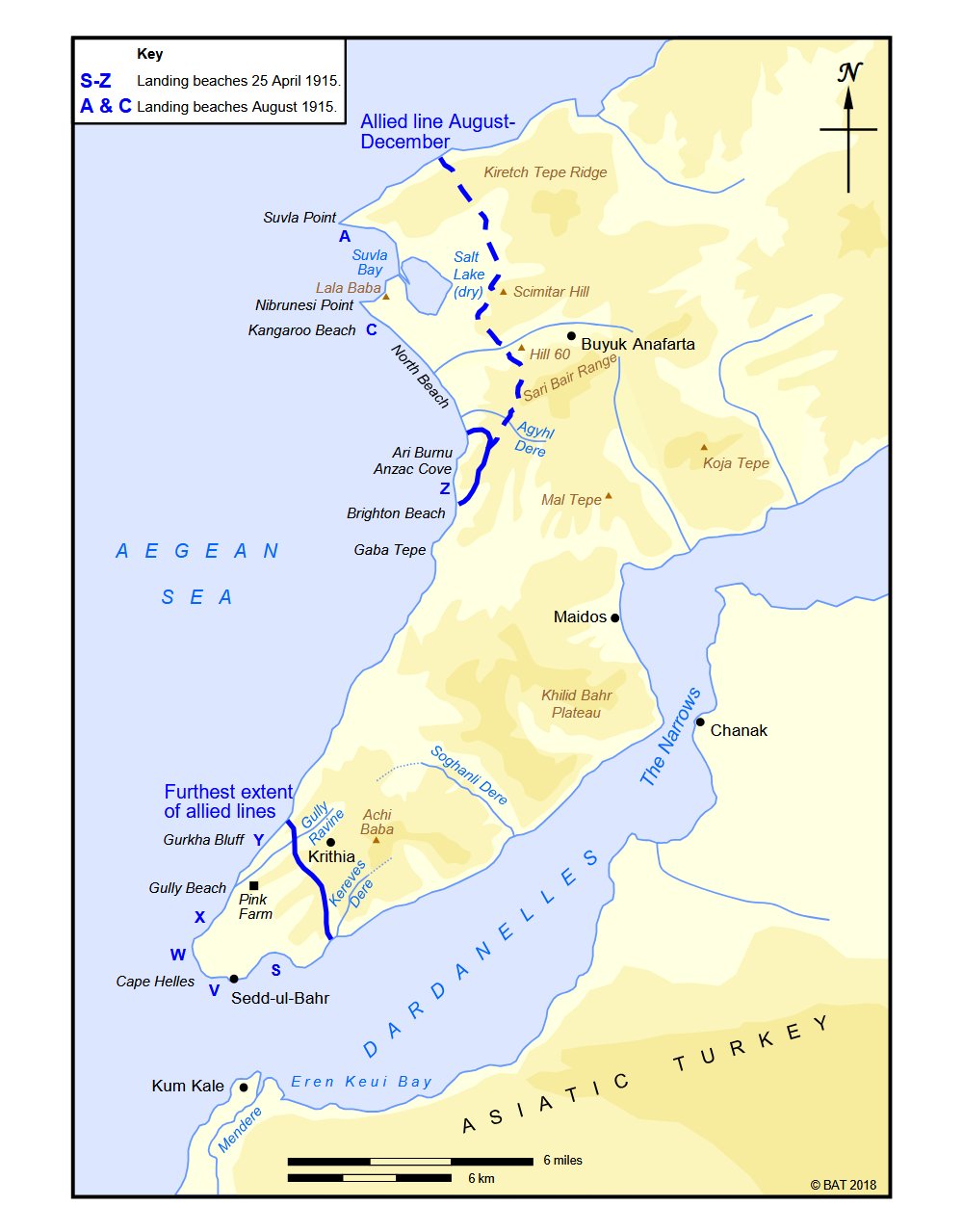
By the third week of April the plans and the initial invasion force were complete, and the landings were timed to begin just before dawn on Sunday, 25 April. Hamilton took the unusual and catastrophic decision to divide his force between two locations: the British 29th Division to land at Helles, on the southern tip of Gallipoli, and the ANZAC troops, supported by 7th Indian Mountain Artillery Brigade, to land further up the Aegean coast at Gaba Tepe, later to become known as Anzac Cove. As the invasion began 29th Division, including three Indian Army transport troops, landed at Helles, after which the SS Ramazan sailed for Gaba Tepe to offload its transport element, often under extremely heavy and withering fire. Apart from 7th Indian Mountain Artillery Brigade and the Mule Cart Train units no other Indian units were involved at this stage.
Two attempts were made by British troops at the Helles end of the Peninsula to consolidate their position from the initial landing beaches and form a line across the tip of the Peninsula. Both involved attempts to take the village of Krithia, the first fought between 25 and 28 April involved no fighting Indian units. It was not until 1 May that the Indian infantry brigade landed at Cape Helles but just two weeks later, on 15 May, the two predominantly Muslim regiments of the Brigade, 69th and 89th Punjabis, were withdrawn on the spurious and wholly unjustified belief that they might not be willing to fight their co-religionists in the Ottoman Army. They were initially sent to France and later to Mesopotamia where Naik Shahmad Khan of 1/89th Punjabis was to win the Victoria Cross in April 1916. The two regiments were replaced on Gallipoli by Gurkha units. In addition to the transport units, the Force included hospitals, medical units and a postal unit, all of which included large numbers of Muslim personnel.
Between 6 and 8 May a second attempt was made to take the village of Krithia. As with the first attempt at the end of April, it was not successful, and in both attacks British troops suffered heavy casualties. 29th Indian Infantry Brigade had been held in reserve for this second attempt on Krithia and suffered light casualties from enemy shelling.
On 4 June Hamilton planned an assault on the Turkish trenches at Helles, in what has become known as the Third Battle of Krithia. Assault troops included 1/6th Gurkhas and 14th Sikhs. Although they broke through the Turkish lines towards Krithia, this advantage was not followed up and the Turkish line held. The British suffered more than 4,500 casualties, the French more than 2,000 and the Turks admitted to more than 9,000 dead and wounded.
For 14th Sikhs the day had been a disaster. It had started with fifteen British officers, eleven Indian officers and 514 men. By the end of the day the battalion had lost twelve British officers, eleven Indian officers and 450 men killed or wounded. The Gurkhas had also suffered heavy casualties. 14th Sikhs were to lose another seven killed and 30 wounded in attacks mounted on 2 July.
By early August the failures to move far from the two original landing sites of Helles and Anzac Cove led to a new initiative being planned, designed to force a breakout from the Anzac beach-head and gain the Sari Bair range, the high ground that dominated the area north of Anzac. There was also to be a feint attack at Helles and a major landing five kilometres north of Anzac Cove at Suvla Bay in order to create a base for later operations. Ian Hamilton’s plan relied upon the arrival of fresh units from Britain. Landing on 5 August, little movement was made for three days, though heavy casualties were taken from Turkish shelling. On 8 August 1/6th Gurkhas did gain the crest of Sari Bair but without adequate support were unable to hold it and the troops were ordered to withdraw. Had the operation been successful it would have cut the Turkish communications on the Helles front. As it was, the failure cost the 14th Sikhs (and their reinforcements from the State of Patiala) dearly, and they numbered just 223 sepoys on 11 August.
The transport units had landed on the very first day of operations and had soon established themselves in what became known as “Mule Gully”. Constantly under enemy fire, they nevertheless kept the front line trenches supplied with ammunition, water and rations, much of the movement being carried out under the cover of darkness. At Anzac alone the transport units suffered casualties of 177 personnel and 858 mules killed or wounded.
On 17 August Sir Ian Hamilton informed Lord Kitchener that the August offensive had failed. He requested 45,000 reinforcements to bring units already on Gallipoli up to strength and another 50,000 to make further offensives possible. Despite the setbacks Hamilton still hoped to gain the high ground above the Anzac beach-head and a further break out was planned for 21 August. Several different attacks were launched but all failed, with the attempt to take Scimitar Hill resulting in some of the largest battles of the entire campaign. “Of the 50,000 British troops engaged at Suvla and Anzac, the casualties in just four days fighting from 7 to 10 August had amounted to at least 18,000; the casualty toll increased to 40,000 by the end of August.”
By the third week of April the plans and the initial invasion force were complete, and the landings were timed to begin just before dawn on Sunday, 25 April. Hamilton took the unusual and catastrophic decision to divide his force between two locations: the British 29th Division to land at Helles, on the southern tip of Gallipoli, and the ANZAC troops, supported by 7th Indian Mountain Artillery Brigade, to land further up the Aegean coast at Gaba Tepe, later to become known as Anzac Cove. As the invasion began 29th Division, including three Indian Army transport troops, landed at Helles, after which the SS Ramazan sailed for Gaba Tepe to offload its transport element, often under extremely heavy and withering fire. Apart from 7th Indian Mountain Artillery Brigade and the Mule Cart Train units no other Indianunits were involved at this stage.
Two attempts were made by British troops at the Helles end of the Peninsula to consolidate their position from the initial landing beaches and form a line across the tip of the Peninsula. Both involved attempts to take the village of Krithia, the first fought between 25 and 28 April involved no fighting Indian units. It was not until 1 May that the Indian infantry brigade landed at Cape Helles but just two weeks later, on 15 May, the two predominantly Muslim regiments of the Brigade, 69th and 89th Punjabis, were withdrawn on the spurious and wholly unjustified belief that they might not be willing to fight their co-religionists in the Ottoman Army. They were initially sent to France and later to Mesopotamia where Naik Shahmad Khan of 1/89th Punjabis was to win the Victoria Cross in April 1916. The two regiments were replaced on Gallipoli by Gurkha units. In addition to the transport units, the Force included hospitals, medical units and a postal unit, all of which included large numbers of Muslim personnel.
Between 6 and 8 May a second attempt was made to take the village of Krithia. As with the first attempt at the end of April, it was not successful, and in both attacks British troops suffered heavy casualties. 29th Indian Infantry Brigade had been held in reserve for this second attempt on Krithia and suffered light casualties from enemy shelling.
On 4 June Hamilton planned an assault on the Turkish trenches at Helles, in what has become known as the Third Battle of Krithia. Assault troops included 1/6th Gurkhas and 14th Sikhs. Although they broke through the Turkish lines towards Krithia, this advantage was not followed up and the Turkish line held. The British suffered more than 4,500 casualties, the French more than 2,000 and the Turks admitted to more than 9,000 dead and wounded.
For 14th Sikhs the day had been a disaster. It had started with fifteen British officers, eleven Indian officers and 514 men. By the end of the day the battalion had lost twelve British officers, eleven Indian officers and 450 men killed or wounded. The Gurkhas had also suffered heavy casualties. 14th Sikhs were to lose another seven killed and 30 wounded in attacks mounted on 2 July.
By early August the failures to move far from the two original landing sites of Helles and Anzac Cove led to a new initiative being planned, designed to force a breakout from the Anzac beach-head and gain the Sari Bair range, the high ground that dominated the area north of Anzac. There was also to be a feint attack at Helles and a major landing five kilometres north of Anzac Cove at Suvla Bay in order to create a base for later operations. Ian Hamilton’s plan relied upon the arrival of fresh units from Britain. Landing on 5 August, little movement was made for three days, though heavy casualties were taken from Turkish shelling. On 8 August 1/6th Gurkhas did gain the crest of Sari Bair but without adequate support were unable to hold it and the troops were ordered to withdraw. Had the operation been successful it would have cut the Turkish communications on the Helles front. As it was, the failure cost the 14th Sikhs (and their reinforcements from the State of Patiala) dearly, and they numbered just 223 sepoys on 11 August.
The transport units had landed on the very first day of operations and had soon established themselves in what became known as “Mule Gully”. Constantly under enemy fire, they nevertheless kept the front line trenches supplied with ammunition, water and rations, much of the movement being carried out under the cover of darkness. At Anzac alone the transport units suffered casualties of 177 personnel and 858 mules killed or wounded.
On 17 August Sir Ian Hamilton informed Lord Kitchener that the August offensive had failed. He requested 45,000 reinforcements to bring units already on Gallipoli up to strength and another 50,000 to make further offensives possible. Despite the setbacks Hamilton still hoped to gain the high ground above the Anzac beach-head and a further break out was planned for 21 August. Several different attacks were launched but all failed, with the attempt to take Scimitar Hill resulting in some of the largest battles of the entire campaign. “Of the 50,000 British troops engaged at Suvla and Anzac, the casualties in just four days fighting from 7 to 10 August had amounted to at least 18,000; the casualty toll increased to 40,000 by the end of August.” [4] Of these, 14th Sikhs suffered thirty casualties, including seven Patialas killed. A further two were killed and two wounded on 26 August.
Hamilton’s call for reinforcements was met partly with drafts from units based in Egypt and on 15 September some of these drafts left Alexandria harbour on board the SS Ramazan, the same ship that had brought the Mule Corps from Egypt in April and further reinforcements in August. As with all such merchant ships, the Ramazan was unarmed and sailed alone without escort. At dawn on 19 September the Ramazan was found by the German submarine U-35 “55 nautical miles off the Greek island of Antikythira, between the north-west point of Crete and the Greek mainland.” [5] The U-boat fired at the transport ship with its deck cannon, smashing some of its lifeboats, and continued to fire at it until the Ramazan sank. Despite repeated appeals by British officers on board the ship, many of the Indian soldiers refused to take to the water and so went down with the ship. We must remember, of course, that coming from the hills of Nepal and the plains of the Punjab very few of them would have been able to swim. Of those who did make it into the lifeboats, one boat capsized but the remaining four made it to Antikythira from where they were taken by Greek warship to Athens and, eventually, via Malta back to Egypt. Of the nearly 400 Indian troops on board the SS Ramazan only between 75 and 93 were saved. At least 80 men of the 14th Sikhs and 173 of the 10th Gurkha Rifles were lost. The Commonwealth War Graves Commission web site also shows 23 members of the Indian Supply and Transport Corps died on 19 September 1915. The site does not specifically mention the SS Ramazan but records show there were no significant engagements on land on that date and so it seems safe to suggest that these 23 men were victims of the attack on the Ramazan.
On 14 October the Dardanelles Committee dismissed General Sir Ian Hamilton as commander of the Mediterranean Expeditionary Force and he was replaced by General Sir Charles Monro. [6] At the end of October Monro advised a complete withdrawal from Gallipoli but Lord Kitchener, unwilling to accept this advice, dismissed him and replaced him with Lieutenant General Birdwood, only to re-appoint Monro having made a personal visit to Gallipoli. Kitchener then repeated Monro’s advice to evacuate and this began from Anzac and Suvla in early December, finally being completed on the morning of 20 December, though done in such a way that the Turks were unaware of it happening. The squeakiest transport carts were used as a decoy to give the impression that it was business as usual. Helles was evacuated on 27 December 1915. The Indian contingent suffered a total of 4,130 casualties during the campaign. Not all were Muslim, though many were. We should remember them all, alongside their Sikh and Gurkha comrades in arms.
Sources
Chhina, Rana T S, India and the Great War – Gallipoli (Delhi: United Service Institution of India, 2018)
Chhina, Rana T S, ‘Their Mercenary Calling, the Indian Army on Gallipoli 1915’ in Ashley Ekins (ed) Gallipoli: a Ridge Too Far (Wollombi: Exisle Publishing, 2013)
McClenaghan, Tony, For the Honour of My House: The Contribution of the Indian Princely
States to the First World War. (Warwick: Helion & Company Limited, 2019)
Stanley, Peter Die in Battle, Do Not Despair (Solihull: Helion & Co in association with USII, 2015)
Acknowledgements
Map by Barbara Taylor from Tony McClenaghan, For the Honour of My House: The Contribution of the Indian Princely States to the First World War. (Warwick: Helion & Company Limited, 2019)
Glossary
1. Rana T S Chhina. India and the Great War – Gallipoli (Delhi: United Service Institution of India, 2018
2. Peter Stanley, Die in Battle, Do Not Despair (Solihull: Helion & Co in association with USII, 2015)
3. Rana Chhina, ‘Their Mercenary Calling, the Indian Army on Gallipoli 1915’ in Ashley Ekins (ed) Gallipoli: a Ridge Too Far (Wollombi: Exisle Publishing, 2013), p. 238.
4. Ashley Ekins, introduction to Ashley Ekins (ed.) Gallipoli: a Ridge Too Far ‘the most ghastly and costly fiasco’.
5. Stanley, Die in Battle, p.255
6. He was later to command the British First Army in France before becoming Commander in Chief India.
SUPPORT US
The WWMMT continues to raise funds for the maintenance of the memorial and for an educational programme focussed on the history of the role Muslims played in the two World Wars and since. If would like to support the Trust and its ongoing work, please donate.
Click to share this page on your social media


